In the bustling world of nonprofit fundraising, it’s easy to get caught up in the volume game—chasing more clicks, more small donations and wider social media reach. While broad support is vital for awareness, the financial engine that truly powers sustainable mission impact lies elsewhere: your major donor program.
A major donor program isn’t just a “nice-to-have”- it is the bedrock of organizational stability! If your nonprofit is relying solely on events and small-dollar direct mail, you are leaving your most significant potential growth on the table.
The 80/20 Rule is Real (and it’s likely closer to 90/10)
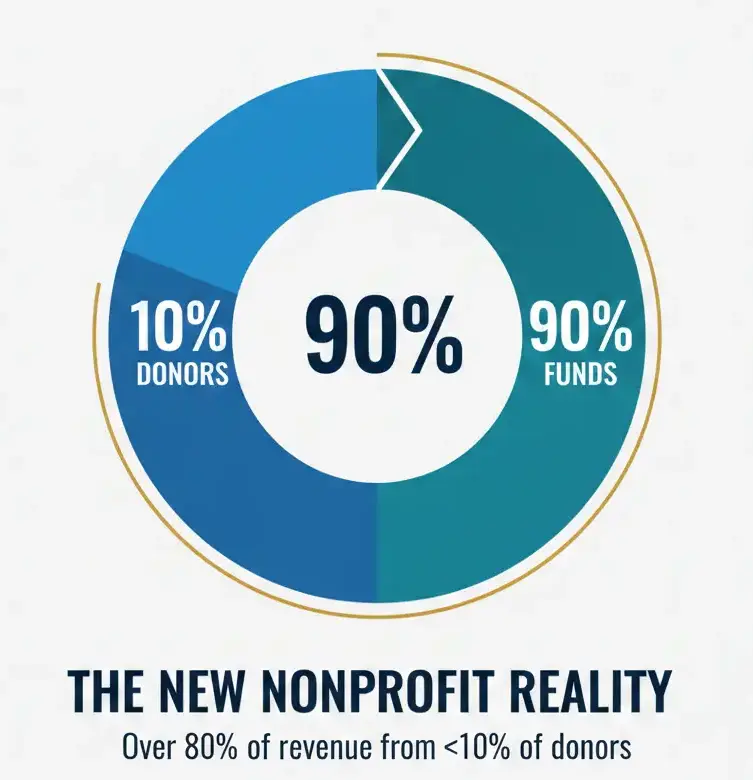
The importance of major donors depends on the famous Pareto Principle. For decades, the general rule in fundraising was that 80% of funds came from 20% of donors.
Today, due to increasing wealth concentration, that ratio is shifting drastically. According to data gathered by the Fundraising Effectiveness Project and analyzing various sector reports, it is now common for organizations to see over 80% of their individual giving revenue come from fewer than 10% of their donors.
Think about that statistic. If you aren’t strategically investing time into that top 10%, you are jeopardizing nearly all your donation revenue. Major donors provide the unrestricted funds that keep the lights on and the large capital infusions that launch new programs. They are investors, not just supporters!
Proven Methods to Improve Your Program
If your major giving program is stagnant, you need to shift from transactional fundraising to relationship fundraising. Here are three proven methods to elevate your approach:
Stop Guessing and Use Your Data: Many nonprofits are sitting on a goldmine of hidden major donors within their existing database. You don’t necessarily need new names. But you need to better understand the names you have!
The Method: Utilize wealth screening tools and analyze past giving behaviors to identify capacity. Look for the “quiet” donors who have given consistently for five years, even in small amounts. Loyalty often signals a willingness to invest more if asked appropriately.
The “Moves Management” Discipline: You cannot treat a $10,000 prospect the same way you treat a $50 donor. Major gifts don’t happen spontaneously; they are cultivated.
The Method: Implement “Moves Management.” This is the structured process of moving a prospect from identification to qualification, cultivation, solicitation and stewardship. Every major prospect needs an assigned relationship manager and a defined “next step.” If a donor doesn’t have a next planned touchpoint, they are being neglected.
Radical Stewardship over Radical Asking: The biggest mistake nonprofits make is ignoring the donor between the check clearing and the next appeal.
The Method: Build a stewardship plan that reports on impact, not just activities. Don’t just thank them for the money; show them what their money did. A personalized video from a program director or a private tour often accomplishes more than a generic annual report. The goal is to make the donor feel like an insider.
Your Immediate Action Items
Ready to upgrade your program? Start this week with these three steps
- Define a “Major Gift”: Is it $1,000 or $25,000? Determine an amount that is significant for your organization’s budget.
- The Top 20 Audit: Identify your top 20 current donors. Call three of them this week just to thank them and ask for their advice on a challenge—do not ask for money.
- Review Portfolio Size: Ensure no fundraiser is trying to manage more than 125-150 active major prospects. Any more than that and personalized relationship-building becomes impossible.
Signup now to receive the latest posts!